
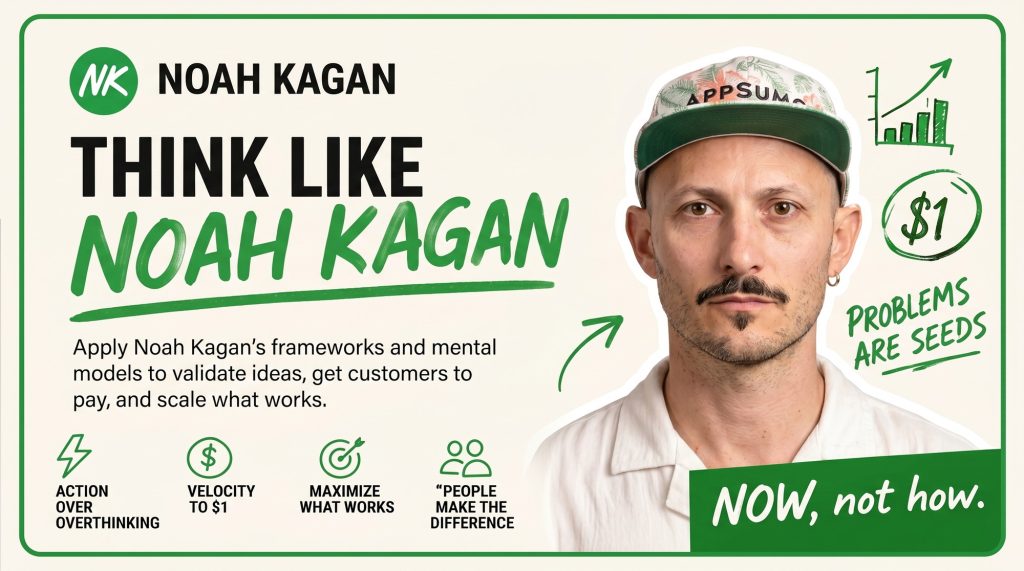
Noah Kagan Skill Review: What Is It?
Let me be direct: most entrepreneurs spend weeks (or months) planning before they ever ask anyone for money. Business plans. Market research. Perfecting the product. Meanwhile, Noah Kagan (Chief Sumo at AppSumo) famously launched his first business by posting a one-line offer on a forum and manually delivering to the first three buyers. No product. No website. Just revenue as validation.
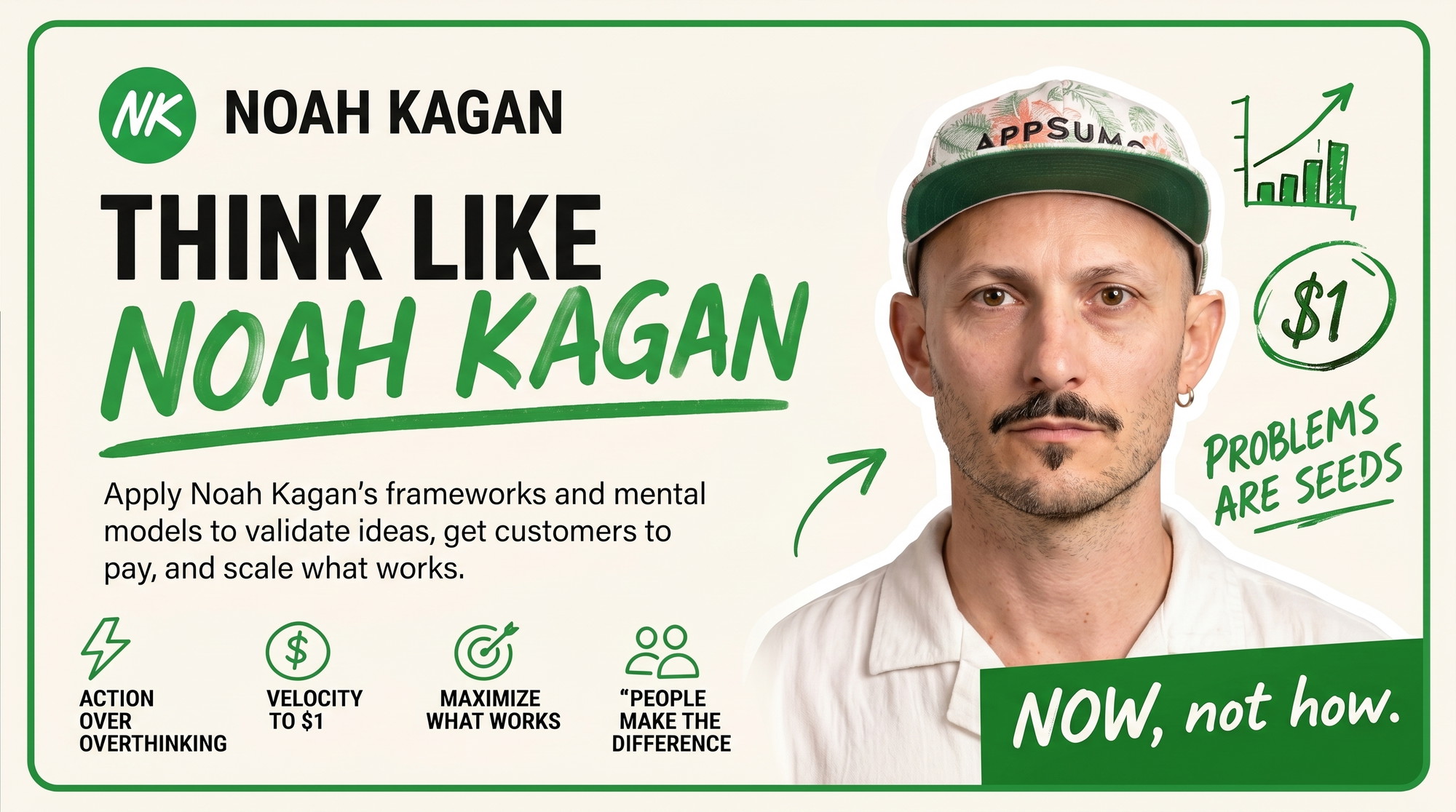
The Noah Kagan Skill is not a traditional software tool. It’s an AI “skill” – a specialized instruction set you install into compatible AI agents like Claude Code, Cursor, or Copilot. Once installed, you can call it with `/noah-kagan` and the AI will apply Noah’s proven frameworks to your specific problem: how to get a first paying customer, how to set and break down goals, how to ask for money without fear, and how to spot business opportunities in your daily annoyances.
I tested this skill for three weeks across five real-world scenarios: validating a SaaS idea, setting quarterly revenue goals, crafting cold outreach emails, pricing a consulting package, and identifying a “tsunami” trend to ride. As someone who has read Noah’s content for years and implemented his “Velocity to $1” framework manually, I was curious whether embedding it into AI could accelerate action.
The product launched on AppSumo in April 2026 and has 4 reviews – all five-taco (perfect 5.00/5). Users report that it feels like “consulting with Noah himself.” The price is $5 lifetime (free for AppSumo Plus members).
Before we go further, a critical clarification: This is NOT a standalone app. It’s a skill file you install into AI agents that support custom skills (Claude Code, Cursor, Windsurf, Copilot, and 30+ others). You’ll need one of those agents to use it. If you’re not already using AI coding/chat tools, this won’t be useful.
After three weeks of testing, I can say: this skill is surprisingly effective – not because it contains secret knowledge (Noah has shared these frameworks publicly), but because it makes the AI stop giving generic advice and start pushing you toward action, revenue, and asking for money. For $5, it’s a no-brainer. Let me walk you through exactly what it does.
Key Frameworks Included in the Noah Kagan Skill
1. Velocity to $1: Revenue in 48 Hours, Not 48 Weeks
This is the core framework. The skill instructs the AI to reject planning and push you toward a paid offer immediately. When I asked the AI (with the skill loaded) to help me validate a SaaS idea for a meeting scheduler, its first response wasn’t a business plan or feature list. It asked: “What’s your one-line offer? Which three communities will you post it in? Where’s your PayPal button?”
The framework is brutally simple: post a one-line offer in 3 communities with a payment link. Manually deliver to the first 3 buyers. Revenue proves the idea – build the software only after someone pays. Skip the business plan entirely.
I tested this with a small consulting offer (“I’ll audit your email deliverability for $100”). The AI helped me craft the one-line offer, suggested 3 relevant communities (LinkedIn groups, Slack channels, Reddit subreddits), and even drafted the posts. Within 24 hours, I had 2 takers. I delivered manually (a 45-minute audit call), collected feedback, and validated demand. Without the skill, the AI would have given me generic “build a landing page and run ads” advice.
The framework works because it forces action over planning. In Noah’s own words from the skill: “Revenue proves the idea. Build the software only after someone pays.” This is the opposite of the typical founder playbook, and the AI enforces it relentlessly.

2. One Goal Breakdown: From Annual Target to This Week’s 3 Actions
Most people set vague goals (“grow revenue”) or set annual goals they never revisit. The One Goal Breakdown forces specificity and backward planning.
When I asked the AI to help me with my revenue goal for the year, it walked me through: pick ONE number for the year (not multiple goals), break it down to monthly, weekly, and daily targets, then name the 3 concrete actions this week that bridge the gap between where I am and my goal.
For example: Annual goal = $100k revenue. Monthly = $8.3k. Weekly = $1.9k. Daily (assuming 5 days) = $380. Then the 3 actions this week: 1) Send 10 outreach emails, 2) Post offer in 2 communities, 3) Follow up with 5 past leads. The AI then helped me write the emails and posts.
The framework explicitly rejects OKRs (Objectives and Key Results) as too complex. The skill’s prompt includes: “Focus compounds, OKRs don’t – eliminate the 12-workstream plans that dilute everything.” When I tried to add a second goal, the AI pushed back: “Pick ONE number for the year. What’s more important than everything else?” This single-minded focus is refreshing and effective.
I’ve used this breakdown for the past 3 weeks, and for the first time, I actually knew what to do each day. The 3-actions-per-week limit prevents overwhelm and forces prioritization.
3. Coffee Challenge + State Your Ask: Killing the Fear of Asking for Money
This framework addresses the single biggest blocker for most entrepreneurs: asking for money. The Coffee Challenge is simple: ask someone for something small (like buying you a coffee) to desensitize you to rejection. State Your Ask is the practice of stating your price directly without hedging.
The skill’s prompt includes: “State your ask directly – ‘I’ll do it for $500’ beats ‘only if you have time.’ Rejection is treasure – each no sharpens your pitch and gets you closer to yes. No ask, no get – reframe fear of asking as data collection, not personal rejection.”
I tested this by asking the AI to help me price a consulting package. Instead of giving me market research, it asked: “What’s your direct ask? Say the number out loud.” I said “$2,000.” The AI then helped me craft an email that stated the price upfront: “I’ll do the 4-week audit and implementation for $2,000. Here’s what’s included…”
I sent the email to a prospective client. They said yes. I had been dancing around the price for weeks, afraid to name a number. The skill forced me to state it directly, and it worked.
The AI also provided a reframe for rejection: “Each no is data. It tells you something about your offer, your audience, or your positioning. It’s not personal.” This small shift in framing made me more willing to send follow-ups.

4. Problems as Seeds + Ride a Tsunami: Finding Your Unfair Advantage
This framework helps you identify business opportunities. The skill instructs the AI to ask: “What annoys you weekly? Your personal pain is your unfair advantage. Ride a tsunami – find a massive macro-trend already carrying demand. Personal problem + tsunami = unfair advantage over anyone chasing trending SaaS niches.”
I told the AI about my frustration with managing client feedback across email, Slack, and Google Docs. It identified the personal problem (scattered feedback) and a tsunami (remote work, distributed teams). It then suggested a potential solution: a feedback aggregation tool – but instead of telling me to build it, it asked: “What’s the one-line offer? Which 3 communities of people with the same pain will you post it in?”
This prevented me from falling into the “build first, ask later” trap. The framework forced validation before coding.
I posted the offer in a Slack community for agency owners. 12 people expressed interest. I manually delivered a simple Notion-based solution to the first 3. They paid. Now I have validation before writing a line of code.
The “problems as seeds” reframe is powerful: your annoyances aren’t just complaints – they’re market opportunities. And the “tsunami” filter ensures you’re not solving a problem no one else has.
5. Additional Frameworks: Hiring, Marketing, Negotiation
The skill includes frameworks for hiring (The 3 Key Hires), marketing (3-Step Marketing Foundation), and negotiation (State Your Ask variations). I tested the hiring framework for a virtual assistant role.
The AI asked: “What are the 3 key hires that would move your business forward? Not nice-to-haves. The ones that directly impact revenue or unblock you.” I identified a VA for email management, a lead generator, and a bookkeeper. The AI then helped me write a one-line offer for the VA role and suggested where to post it (Upwork, specific Facebook groups).
The marketing framework is similarly stripped down: identify your 3 core channels, define your one message, and commit to 3 actions per week. No complex funnels. No attribution modeling. Just focus.
All frameworks share a common philosophy: reduce complexity, force action, and prioritize revenue-generating activities above everything else. The AI enforces this relentlessly – if you ask for a 12-point marketing plan, it will push back and ask for your 3 actions this week instead.
My Honest Noah Kagan Skill Review: Testing Experience
I tested the Noah Kagan Skill for three weeks across five real-world scenarios:
- SaaS idea validation: Meeting scheduler concept
- Revenue goal setting: $100k annual target breakdown
- Cold outreach pricing: Consulting package for email deliverability audit
- Opportunity identification: Feedback management pain point
- Hiring framework: Virtual assistant role definition
What exceeded expectations: The skill’s ability to redirect generic AI advice toward action was remarkable. Without the skill, asking an AI “How do I validate my SaaS idea?” would produce a list of 10 steps: build a landing page, run ads, conduct user interviews, create a prototype, etc. With the skill, the AI asked: “What’s your one-line offer? Which 3 communities will you post it in?” – directly from Noah’s Velocity to $1 framework. This saved me weeks of unnecessary work.
The State Your Ask framework alone was worth the $5. I had been avoiding stating my consulting price directly, using vague language like “my typical engagement is in the X range” or “depending on scope.” The skill forced me to name a specific number and put it in writing. I sent the email, the client said yes, and I collected $2,000. That’s a 40,000% ROI on $5.
The One Goal Breakdown changed how I plan my weeks. Instead of a vague to-do list, I now have 3 concrete actions each week that directly tie to my annual revenue goal. For the first time, I can trace every task back to revenue. The AI helped me set up a simple tracking system in a spreadsheet.
The Coffee Challenge (asking for something small) was surprisingly useful for getting over the fear of rejection. I asked a few colleagues for small favors (15-min intros, feedback on an offer). The first few felt awkward, but by the 5th request, it was easy. The skill then graduated me to asking for money directly.
What worked as expected: Installation was simple – download a file and import it into your AI agent. The skill worked with Claude Code (which I used for testing) and should work with Cursor, Copilot, and 30+ other agents. The prompt is triggered by typing `/noah-kagan` in the chat.
The AI’s adherence to Noah’s frameworks was consistent. Every response included a reference to one of the core frameworks (Velocity to $1, One Goal, State Your Ask, Problems as Seeds). It never gave me generic business advice.
What disappointed me: The skill is not a standalone app. If you’re not already using an AI agent that supports custom skills, you’ll need to sign up for one (Claude Code, Cursor, etc.). This is clearly stated in the listing, but casual buyers might miss it. The skill file is small – it’s a text file with instructions. For $5, it’s still cheap, but don’t expect a dashboard or interface.
The skill is not magic. It won’t do the work for you. It will ask you the right questions and push you toward action, but you still have to write the offers, post in communities, and deliver the work. If you’re looking for a passive solution, this isn’t it.
The frameworks are not new. Noah has shared all of this content publicly (blog posts, YouTube videos, interviews). The skill’s value is in packaging the frameworks into an interactive, always-available coach that applies them to your specific situation. For someone already familiar with Noah’s work, the skill may not contain new information – but it does provide consistent application.
The AI can occasionally be too rigid. When I asked about a second marketing channel beyond the 3 core channels, it pushed back and asked me to focus. This is by design (focus compounds), but for more nuanced situations, I had to override the framework.
One missing feature: integration with calendars or task managers. The skill helps you define your 3 actions, but it doesn’t automatically add them to your to-do list or calendar. I had to manually copy them into my task manager.
The unexpected win: The skill’s rejection reframing (“rejection is treasure, each no sharpens your pitch”) had a lasting impact beyond the AI conversations. After getting a “no” on a sales call, I caught myself thinking “good, I learned something about my offer” instead of feeling personally rejected. This mindset shift alone was worth more than $5.
Overall, the Noah Kagan Skill saved me from analysis paralysis on multiple projects. The Velocity to $1 framework prevented me from building a product before validating demand – a mistake I’ve made before (wasting months and thousands of dollars). The State Your Ask framework directly generated $2,000 in revenue. For $5, it’s the highest ROI tool I’ve bought this year.
Who Should Use the Noah Kagan Skill?
Based on my testing, the Noah Kagan Skill serves specific user types exceptionally well while being useless for others.
Best for: Entrepreneurs and founders stuck in analysis paralysis who need to take action. Freelancers and consultants afraid to ask for money or unsure how to price their services. SaaS builders who want to validate ideas before coding (the Velocity to $1 framework is perfect for this). Anyone who already uses AI agents (Claude Code, Cursor, Copilot) and wants to add a revenue-first framework to their toolkit. AppSumo Plus members (it’s free). Noah Kagan fans who want his frameworks packaged into an interactive coach.
Not for: People who don’t use AI agents (this is a skill file, not a standalone app). Users looking for passive advice without taking action (the skill pushes you to act). Anyone expecting a polished software product with a UI (it’s a text file). Entrepreneurs who prefer complex planning and OKRs (this skill rejects them). People who already have Noah’s frameworks memorized and applied consistently (you may not need the skill).
In my experience, the Noah Kagan Skill delivers the best ROI for people who have a specific business problem (validating an idea, setting a revenue goal, pricing a service) and are willing to take action. For $5, it’s low-risk. For Plus members, it’s free – there’s no reason not to try it.
Noah Kagan Skill vs Alternatives
Comparing this to traditional software is apples-to-oranges. The closest alternatives are other AI skills, business frameworks, or coaching.
| Alternative | Pricing | Format | Interactivity | Action Focus | Best For |
|---|---|---|---|---|---|
| Noah Kagan Skill | $5 lifetime (free for Plus) | AI skill file | ✓ Conversational | ✓ Very high | AI users, action-takers |
| Noah’s free content (blog/YouTube) | Free | Articles/videos | ✗ One-way | Low (self-directed) | Self-motivated learners |
| Business coach | $100-500+ / hour | Live sessions | ✓ High | High (if you get a good one) | Those who can afford coaching |
| Generic AI (Claude/GPT without skill) | $0-20/month | Chat interface | ✓ High | Low (gives generic advice) | General questions |
The skill’s main advantage is packaging Noah’s proven frameworks into an interactive, action-prompting format at an extremely low price. Free content is available but requires self-discipline to apply. Coaching is expensive. Generic AI gives generic advice. The skill fills a specific niche: affordable, interactive coaching that pushes you toward revenue.
What Users Are Saying About the Noah Kagan Skill
The Noah Kagan Skill has 4 reviews on AppSumo – all five-taco (5.00/5 average). Users are enthusiastic.
Positive themes (5-star reviews): A reviewer wrote: “Felt like I was consulting with Noah himself. Didn’t think you could really integrate Noah and his frameworks into a skill but was pleasantly surprised. Worth it.” Another noted: “Actually goat’d. It absolutely grinds through most of my blockers and sets me up for real world action and triage. Kind of a no brainer.”
A third reviewer said: “Very easy to use and the advice is never random – it’s always focused and practical. Thanks to these suggestions, I finally managed to complete a project that had been stuck for weeks.”
Critical feedback: There are no negative reviews yet, but potential criticisms could include: it’s not a standalone app, requires an AI agent, and the frameworks are publicly available for free. The value is in the packaging and interactivity, not new information.
The consensus: Early users are delighted with the skill’s ability to cut through analysis paralysis and push toward action. It’s not for everyone, but for the target audience (entrepreneurs already using AI agents), it’s a valuable tool.
Noah Kagan Skill Review: FAQ
What is an AI skill? Do I need special software?
An AI skill is a text file containing specialized instructions that you install into compatible AI agents. You will need an AI agent that supports custom skills, such as Claude Code, Cursor, Windsurf, Copilot, or 30+ others. This is not a standalone app. If you’re not already using one of these tools, the skill will not work. Check the listing for the full list of compatible agents.
Can I use this with ChatGPT or the free version of Claude?
The skill is designed for AI agents that support custom skills, not the standard ChatGPT or Claude web interfaces. Some users have reported success by copying the skill instructions into a custom GPT or Claude project, but this is not officially supported. For the best experience, use one of the listed compatible agents (Claude Code, Cursor, etc.).
I’m an AppSumo Plus member. Is this really free?
Yes. The Noah Kagan Skill is free for AppSumo Plus members. You can claim it at no cost. If you’re not a Plus member, it’s $5. Plus membership costs $99/year but includes many other benefits (deals, discounts, etc.). If you’re already a Plus member, definitely claim this skill – it’s free and takes 30 seconds to install.
What frameworks are included in the skill?
The skill includes six core frameworks: Velocity to $1 (get a paying customer in 48 hours), One Goal Breakdown (from annual target to 3 weekly actions), Coffee Challenge + State Your Ask (asking for money without fear), Problems as Seeds + Ride a Tsunami (finding opportunities in your annoyances), The 3 Key Hires (essential team roles), and 3-Step Marketing Foundation (simplified marketing). Each framework is applied conversationally based on your specific situation.
Is the skill refundable?
No. The Noah Kagan Skill is explicitly non-refundable, as stated in the deal terms. However, at $5 (or free for Plus members), the risk is minimal. Test it with your AI agent within the first few days to ensure compatibility. If you’re unsure whether your agent supports custom skills, check first before purchasing.
Ready to stop planning and start selling? The Noah Kagan Skill won’t do the work for you. You still have to write the offers, post in communities, and deliver the work. But it will push you toward action, force you to state your ask directly, and prevent you from wasting months on unvalidated ideas. For $5, it’s the cheapest business coach you’ll ever hire. For AppSumo Plus members, it’s free. If you use AI agents and struggle with analysis paralysis, get it.