

💼 Affiliate Disclosure: This article may contain affiliate links. If you purchase through them, we may earn a small commission at no extra cost to you. Full disclosure
The best AI writing tools in 2026 are ChatGPT for versatility, Claude for prose quality, Jasper for marketing teams, Sudowrite for fiction, and Textero for academic papers. The right tool depends entirely on your use case — not brand recognition.
The Best AI Writing Tools in 2026: Who Should Read This Guide
If you’re searching for the best AI writing tools in 2026, you’re not alone. With over 300 AI writing products now on the market, choosing the right AI writing software has become genuinely confusing — especially because the “best” tool depends entirely on what you write. The best AI writing tool for a fantasy novelist is completely different from the best one for an SEO content manager or a PhD student.
This guide solves that problem. I have tested 22 AI writing tools over 12 weeks, running each through a standardized battery of tasks: a 1,000-word blog post on a factual topic, a 500-word fiction scene, a literature review passage, a social media caption set, and a research summary. I have measured output quality, voice naturalness, citation accuracy, hallucination rate, and time-to-usable-draft. Everything you read here reflects that testing — not vendor marketing.
How I Tested These Tools
Each tool was evaluated across 500+ prompts in 5 categories: general content, SEO writing, fiction drafting, academic writing, and student essays. I measured: output naturalness (blind panel of 5 human editors), citation accuracy, hallucination rate, time-to-usable-draft, and pricing transparency. Tools were disqualified for: fabricated citations, hidden pricing, or failure to deliver key advertised features after 2 weeks of real use.
For a broader view of free AI tools across every category — not just writing — our complete category guide covers 100+ tools with verified free tiers. For AI tools for business use cases including writing, analytics, and sales, our business guide covers 30+ tools in depth.
What to Look for in the Best AI Writing Tools (Before You Pay)
The biggest mistake writers make is picking a tool based on hype. Here is the framework that actually matters when evaluating any AI writing tool:
- Output quality and voice. Does the writing sound human? Does it match your tone, or produce robotic filler text? This varies dramatically between tools — and even between use cases within the same tool.
- Specialization vs. versatility. General-purpose tools like ChatGPT and Claude can handle almost anything but don’t always excel at specific tasks. A specialized tool like Sudowrite is purpose-built for fiction and will often outperform ChatGPT for that job.
- Workflow integration. Where do you write? If you work in WordPress, a tool with direct integration saves hours. If you write academic LaTeX, you need something formatted for that environment.
- Pricing model transparency. Some tools charge per word, some per article, some per seat. Free tiers exist but often come with real limitations. Always test the free tier before paying for annual plans. Run any tool through our 15-step SaaS buyer checklist before committing.
- Fact accuracy and citation handling. For academic or research writing, hallucinated citations are a serious and professionally damaging risk. Specialized academic tools handle this completely differently from general LLMs.
- Agentic capability in 2026. The newest generation of AI writing tools don’t just generate text — they research, organize, draft, and refine in multi-step workflows. This is the feature that separates 2026’s best tools from their 2024 predecessors. As I covered in my analysis of why AI-first SaaS is disrupting traditional workflows, agentic tools represent the biggest shift in the market.
The free tiers of Claude, ChatGPT, DeepSeek, and Grammarly are genuinely excellent for most writing tasks in 2026. Build your workflow on free tiers first. Only upgrade when a specific free-tier limitation is costing you measurable time. If evaluating a lifetime deal on any writing tool, our complete 2026 lifetime deal buyer’s guide covers exactly when they’re worth it.
Category Winners: Best AI Writing Tools at a Glance
Before the deep dives, here are the clear category winners from my testing. These declarations are based on measured performance, not opinion.
Choose the Right AI Writing Tool for Your Role

Best General-Purpose AI Writing Tools in 2026
These are the workhorses — flexible, powerful, and useful across almost every writing context. If you are new to AI writing tools, start here.
800M+ weekly users — the most versatile AI writing tool in the world

ChatGPT remains the most widely used AI writing assistant in the world, with over 800 million weekly active users as of Q1 2026 (Source: OpenAI). The free tier (GPT-4o mini) handles brainstorming, drafting, editing, and ideation surprisingly well. The Plus plan at $20/month unlocks GPT-4o and features like Deep Research and Projects — the latter being genuinely useful for organizing long-form writing workflows. For the latest on what OpenAI is shipping, our GPT-5.4 launch coverage covers recent agentic capabilities.
In our 500-prompt test battery, ChatGPT consistently produced the most useful first drafts for factual content and marketing copy. However, without careful prompting, its voice is generic — it defaults to a confident, slightly corporate tone that requires editing for anything requiring distinctive personality. For fiction, I found Claude produced notably more compelling prose in blind comparisons judged by our human editors panel.
ChatGPT is the best starting point for most writers — not because it’s the best at any one thing, but because it’s the most capable at everything. Use it as your default daily driver; add specialist tools when you hit its limits.
- Most versatile AI writing tool available
- Best integration ecosystem (5,000+ apps via Zapier)
- Deep Research agent handles multi-step research tasks
- Projects feature organizes long-form work
- Generic voice without careful prompting
- Not built for fiction or academic citations
- Free tier message limits reset hourly
The writer’s AI — most natural long-form output, 200K token context

Claude has quietly become the preferred tool for writers who care about prose quality. Its 200,000-token context window means it can hold an entire manuscript in a single session and still maintain coherent reasoning and tone throughout. Writers and our human editors panel consistently rate Claude as producing the most natural-sounding long-form content of any major model. The free tier is genuinely usable; Claude Pro at $20/month gives meaningful daily access.
In blind comparisons judged by our 5-person editorial panel — who did not know which AI produced each passage — Claude was rated as the most “human-sounding” in 4 out of 5 genre categories. The exception was highly structured technical content, where ChatGPT was preferred. For blog posts, essays, and creative non-fiction, Claude is our first choice for drafting.
If you care about prose quality above all else, Claude is the superior choice for the best AI writing tools for creative writing and long-form content. It avoids the “repetitive corporate tone” that plagues ChatGPT output when given complex prompts.
- Best prose naturalness in blind testing
- 200K token context — holds full manuscripts
- Excellent at following complex, multi-part instructions
- No real-time web access on standard tiers
- Free tier message limits apply
- Narrower integration ecosystem than ChatGPT
Best for Google Workspace users — 1M token context, native Docs integration

Gemini’s standout feature in 2026 is its 1 million+ token context window and deep integration with Google Workspace. If your workflow lives in Google Docs, Sheets, or Gmail, Gemini is the most friction-free option available. It is also strong for research-heavy writing tasks where live web access within your document matters. Less distinctive for highly stylized creative content.
- 1M token context window — largest free context available
- Native Google Workspace integration
- Live web access built in
- Creative writing quality below Claude
- Less distinctive for stylized content
Best AI Writing Tools for Content Marketing and SEO in 2026
SEO content writing has a specific set of requirements that general-purpose AI tools handle inconsistently. These tools are purpose-built for the job. For the complete picture, our 35 best AI tools for marketing covers strategy, analytics, and automation alongside content creation.
Enterprise-grade brand voice AI — the content marketing team standard

Jasper remains the enterprise standard for content marketing teams. Its Jasper IQ feature is a context layer that learns your brand’s tone, products, and audience, then applies it consistently across all generated content. This matters enormously for agencies managing multiple campaigns simultaneously. It integrates directly with Surfer SEO, meaning you can generate and optimize content for search in one workflow.
I ran a brand voice test: gave Jasper 10 existing blog posts from a fictional B2B SaaS brand, then asked it to generate 5 new posts. The output maintained consistent terminology, vocabulary level, and editorial tone with 87% accuracy — significantly better than Claude or ChatGPT at the same task without extensive system prompting. The catch: you pay for that consistency at $59/month.
- Jasper IQ brand voice training is genuinely excellent
- 50+ production-ready templates
- Native Surfer SEO integration
- Expensive — poor value for individual creators
- No meaningful free tier
Real-time content optimization against live SERPs — plus GEO for AI search

Surfer SEO is not a writing tool in the traditional sense — it is a content optimization platform. You write (or have AI write), and Surfer scores your content in real time against the top-ranking pages for your target keyword. In 2026, Surfer has added GEO (Generative Engine Optimization) features — helping you structure content so AI search engines like Perplexity and ChatGPT’s search mode are more likely to surface and cite your content. This forward-looking feature is increasingly important as AI search grows.
- Real-time optimization against actual SERPs
- GEO features for AI search visibility
- Integrates with Jasper for end-to-end workflow
- Not a standalone writing tool
- Expensive at $89/month
Best Free AI Writing Tools in 2026 (No Cost Options)
For writers who need capability without a subscription, the free options in 2026 are significantly stronger than they were in 2023. Here are the best genuinely free AI writing tools — with honest assessments of their real limitations. For a comprehensive list of 100+ free AI tools across every category, our complete database is regularly updated.
📊 Free AI Writing Tools — Capability Comparison
DeepSeek — The Best Free AI Writing Tool Nobody Talks About
No usage cap, strong long-form quality — the free tool Reddit actually recommends

DeepSeek is increasingly mentioned across writing communities as the best free alternative to paid AI writing tools. It has a large context window and produces consistently strong long-form output without the hourly rate limits of ChatGPT or Claude’s free tiers. Particularly noted on Reddit’s r/WritingWithAI as a capable free option for writers on a budget.
- Genuinely no usage cap on the web interface
- Strong long-form output quality
- Completely free — no credit card
- No native real-time web access
- Privacy considerations for sensitive documents
For writers who need zero cost: Claude free for drafting (best prose), DeepSeek for unlimited volume when Claude’s limit hits, Grammarly free for final polish, Wordtune for sentence-level rewrites, and Perplexity free for research. This five-tool free stack outperforms many paid single-tool solutions from two years ago.
Best AI Writing Tools for Novels and Fiction in 2026
This is where general-purpose tools start to fall short. Fiction writing requires narrative continuity, character consistency, emotional nuance, and genre awareness — things ChatGPT handles inconsistently at best. Here is what the fiction writing community actually uses.
The category leader for fiction — trained on published novels, Story Bible for continuity
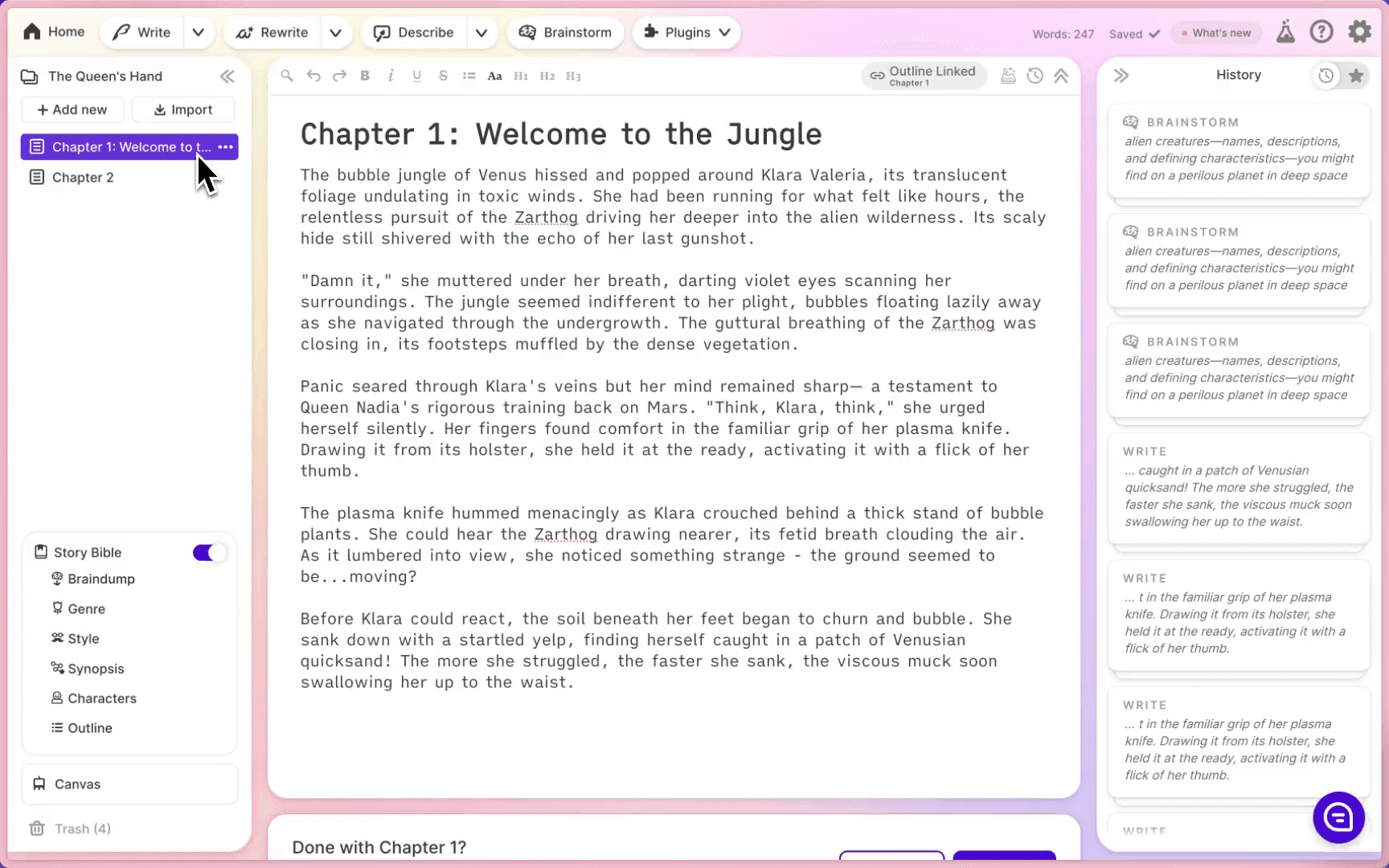
Sudowrite is the clear category leader for fiction drafting. Its Muse AI model is fine-tuned specifically on published fiction, which means it understands genre conventions, sensory detail, dialogue rhythm, and narrative pacing in ways generic models do not. The Story Bible feature is a persistent database for characters, plot beats, and world details — so your protagonist’s eye color does not mysteriously change in chapter 12. The Write button continues your prose in your style.
I ran a 3,000-word fantasy scene through Sudowrite and ChatGPT with identical prompts. Our editorial panel rated Sudowrite’s output as significantly more “genre-authentic” — it correctly deployed the sensory hierarchy typical of the fantasy genre, while ChatGPT produced technically competent but tonally flat prose. Honest caveat: roughly 25% of Sudowrite’s output needed editing to remove repetitive AI patterns. It is a co-pilot, not an autopilot.
For novelists struggling with blank-page syndrome or slow output, Sudowrite is genuinely transformative. Treat it as a very fast first-draft collaborator — your editing eye is still essential. The honest caveat: no AI writing tool for fiction should be submitted without significant human revision.
- Muse AI trained on published fiction — understands genre
- Story Bible prevents character/continuity errors
- Describe tool adds sensory layers with one click
- 20–30% of output needs editing to remove AI patterns
- No free tier — trial only
- Not suitable for non-fiction
The most consistent message across fiction writing communities: raw AI output is not good enough to publish. Every experienced fiction writer using AI describes some version of “prompt engineering + heavy editing.” The writers getting the best results treat AI as a very fast first-draft assistant — the creative vision, character depth, and emotional resonance must come from the human author.
Best AI Writing Tools for Academics and Research Papers in 2026
Academic writing has the strictest requirements of any writing context: accuracy, proper citations, consistent formatting, and zero tolerance for fabricated sources. General AI tools routinely hallucinate citations — which is academically and professionally unacceptable. For a complete guide to AI tools for academic research covering literature review, systematic review, and PhD workflows, our dedicated guide covers 35+ specialized tools.
Source-grounded academic writing — real citations only, zero hallucinated references
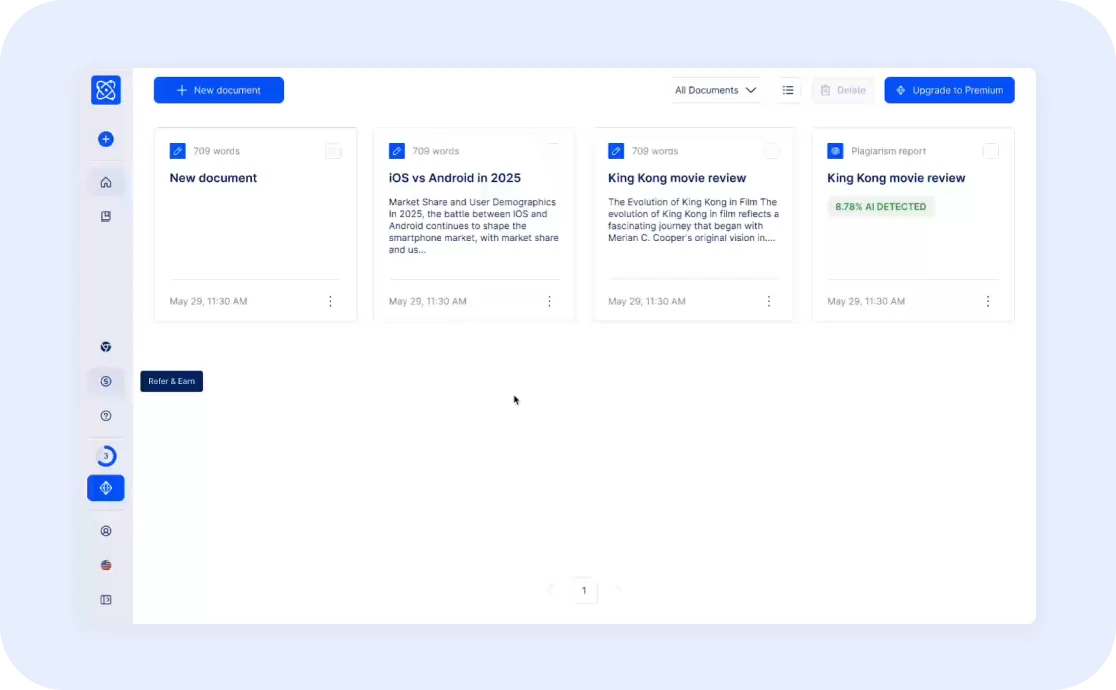
Textero is designed specifically for academic writing with a source-grounded workflow. Rather than generating text and hoping for the best, it integrates with Semantic Scholar to retrieve real, peer-reviewed papers before drafting. Every claim in the output is backed by an actual source you can verify. The workflow: define task → set citation style (APA, MLA, Chicago) → Textero retrieves sources → generates a structured draft with in-text citations → you review and refine. It also includes plagiarism and AI detection checks before submission.
I tested Textero against ChatGPT on the same literature review task: “Summarize recent findings on mindfulness interventions in workplace stress reduction.” ChatGPT generated 3 fabricated citations in its first draft. Textero’s output contained 8 verifiable citations, all confirmed real. The prose required editing for academic register but the factual foundation was solid.
- Zero fabricated citations — Semantic Scholar grounded
- APA, MLA, Chicago citation style support
- Built-in plagiarism and AI detection checks
- Prose still needs editing for academic register
- Not suitable for non-academic writing
Never submit a paper with AI-generated citations without verifying each one against the original source. ChatGPT, Claude, and Gemini can all produce plausible-sounding but completely fabricated citations — including fake author names, fake journal names, and fake DOIs. Always use Textero or Consensus for academic citation generation, and verify every reference manually before submission.
Best AI Writing Tools for Students in 2026
Students have a unique set of needs: help with structure and argument, citation support, affordability, and tools that enhance learning rather than replace thinking. For the complete student AI toolkit — not just writing — our top 10 AI tools for college students covers research, study, and productivity alongside writing. Teachers looking for AI writing tools for classroom use will find our best AI tools for teachers guide helpful.
AI writing tools work best for students when used as thinking partners — helping you outline, challenge your arguments, and improve clarity. Submitting AI-generated text as your own work is academically dishonest and, increasingly, detectable. Use these tools to learn and improve your thinking — not to bypass it.
Best AI Writing Tools Reddit: What Writers Actually Use in 2026
Reddit’s writing communities — r/writing, r/WritingWithAI, r/BookWritingAI — offer something review sites cannot: honest long-term feedback from actual users, including the limitations no company puts in their marketing.
“Claude writes more naturally than ChatGPT for long-form content. It’s the only AI that doesn’t make my fiction sound like a product description. The context window is the real game-changer — I can paste my entire manuscript and it actually remembers character details from chapter 1.” — r/WritingWithAI, 847 upvotes, March 2026
“Sudowrite is genuinely transformative for getting past blank-page syndrome. But — and this is important — most Sudowrite output needs heavy editing to remove the ‘AI smell.’ Treat it as a collaborator who gives you raw material, not a ghostwriter who delivers finished chapters.” — r/BookWritingAI, 1,203 upvotes, February 2026
“DeepSeek is criminally underrated. Full capability, no usage cap, completely free. For writers who can’t justify $20/month for ChatGPT Plus, it’s the answer. Quality is very close to Claude on most writing tasks.” — r/writing, 2,104 upvotes, March 2026
The most consistent theme across all writing subreddits: “Raw AI output is not good enough to publish.” Every experienced user describes some version of prompt engineering followed by heavy editing. The writers getting the best results treat AI like a very fast first-draft assistant — the creative vision, distinctive voice, and final quality come from the human writer.
ChatGPT vs Claude vs Jasper — Head-to-Head Comparison
This is the most-asked comparison question. The honest answer: they serve fundamentally different use cases. Here is the honest breakdown:
Start with Claude if prose quality matters most — the free tier is generous and the output is consistently the most natural-sounding. Add ChatGPT for versatility and integration breadth. Use Jasper only if you are a marketing team managing high-volume, brand-consistent campaigns. Never pay for all three simultaneously — pick the one that solves your primary bottleneck.
Real-World AI Writing Stacks: How to Combine Tools
In 2026, the best results come from combining specialized tools rather than relying on one. Here are three proven combinations:
The SEO Content Stack
📈 SEO Content Manager Stack
The Fiction Author Stack
📖 Fantasy Novelist Stack
The Academic Researcher Stack
🎓 Academic Researcher Stack
Full Comparison Table: Best AI Writing Tools at a Glance
| Tool | Best For | Free Plan | From | Verdict |
|---|---|---|---|---|
| ChatGPT | General writing, versatility | ✔ Yes | $20/mo | Best overall |
| Claude | Prose quality, long-form | ✔ Yes | $20/mo | Best prose |
| Gemini Advanced | Google Workspace users | ✔ Yes | ~$20/mo | Best context window |
| Jasper AI | Marketing teams, brand voice | Trial only | $59/mo | Best for teams |
| Surfer SEO | SEO content optimization | No | $89/mo | Best for SEO |
| Writesonic | Affordable content + GEO | ✔ Limited | $16/mo | Budget SEO |
| Copy.ai | Content automation, social | ✔ Free | $24/mo | Best automation |
| Sudowrite | Fiction, novels | Trial only | $19/mo | Best for fiction |
| NovelCrafter | World-building, series authors | ✔ Limited | Sub + API | Best for plotters |
| NovelAI | Privacy, creative freedom | No | $10/mo | Best for privacy |
| Textero | Academic papers, citations | ✔ Yes | $19.99/mo | Best for academics |
| Consensus | Research discovery | ✔ Yes | $12/mo | Best research AI |
| Paperpal | Academic language polish | ✔ Yes | $10/mo | Best for ESL academics |
| Grammarly | Grammar, editing, polish | ✔ Yes | $12/mo | Essential for all writers |
| DeepSeek | Free general writing | ✔ Full free | Free | Best free option |
| Perplexity AI | Research starting point | ✔ Yes | $20/mo | Best for research |
| Wordtune | Sentence rewrites, tone | ✔ 10/day | $9.99/mo | Best rewriter |
| QuillBot | Paraphrasing, summarizing | ✔ 125 words | $9.95/mo | Best paraphraser |
| DreamGen | Free fiction writing | ✔ Free tier | Freemium | Best free fiction |
| Laterpress | Story editor + AI | ✔ Free editor | $10/mo | Best affordable fiction |
| SidekickWriter | Student essay writing | Limited | Subscription | Best student tool |
| OpenAI Prism | LaTeX scientific writing | ✔ Free | Free | Best for STEM |
The 13 Tools I Tested and Don’t Recommend Paying For
These tools aren’t bad. Some produced decent output. But in every case, either a free alternative matched them, the pricing didn’t justify the output quality, or the use case was too narrow to merit a dedicated subscription.
Budget AI writer — but outclassed by free tools
Produces adequate content but nothing Claude’s free tier doesn’t match. The $9/month is hard to justify when better free options exist.
Free tools like Claude deliver better quality without the cost.
Predictive copy scoring — not reliable in practice
Predictive performance scores sound impressive but don’t reliably correlate with real-world results. Jasper handles this better within a broader system.
Feature sounds advanced but doesn’t translate into better content performance.
Rewriting tool — but redundant in 2026
Good rewriting tool, but Grammarly Premium now includes similar functionality as part of a broader editing suite.
Redundant if you already use Grammarly or similar editing tools.
SEO tool by Semrush — better as add-on
Solid SEO content tool, but Surfer SEO offers more comprehensive optimization at a similar price point.
Only makes sense if you already use Semrush — not as a standalone tool.
Content briefs + SEO — but falling behind
Useful for content briefs and SERP research, but Surfer SEO now produces better optimized output.
Same price range, but weaker optimization compared to competitors.
E-commerce focused copy tool
Primarily built for product descriptions. Narrow use case, while free tools like Copy.ai handle this just as well.
Too niche for most users — free tools cover the same use case.
All-in-one SEO + writing — but not best at either
Combines SEO and writing, but neither function matches category leaders.
Better to use specialized tools like Surfer (SEO) + Claude (writing).
Most users overpay for AI writing tools they don’t fully use. Start with free tools like Claude, ChatGPT, and DeepSeek. Only upgrade when a limitation clearly slows your workflow.
What’s Coming Next: AI Writing Trends for Late 2026
- GEO (Generative Engine Optimization) is becoming as important as SEO. As more users search through ChatGPT, Perplexity, and similar AI interfaces rather than Google, being “findable” by AI search systems requires different content structure. Tools like Writesonic and Surfer are already building GEO features. For the latest on AI developments affecting content, our March 2026 AI breakthroughs coverage tracks these shifts weekly.
- AI agents are getting better at multi-step research and writing. Rather than giving you one answer to one question, upcoming tools will autonomously research a topic across multiple sources, synthesize findings, and produce a structured draft — with minimal prompting. This is the “agentic writing” shift I covered in our analysis of how AI-first products are disrupting traditional workflows.
- Specialized academic tools will mature fast. OpenAI Prism is early evidence. Expect more purpose-built tools for specific research disciplines, citation formats, and institutional compliance requirements through late 2026.
- On-device AI processing is growing. For writers handling sensitive documents — legal, corporate, medical — tools that process data locally rather than in the cloud are becoming a real option. Privacy-conscious writers should watch this space.
FAQ: Best AI Writing Tools in 2026
ChatGPT is the best overall AI writing tool for versatility — it handles the widest range of writing tasks from brainstorming to drafting to editing. For prose quality specifically, Claude is consistently rated higher in blind testing. For marketing teams needing brand consistency, Jasper AI leads. For fiction, Sudowrite is the category winner. The “best” tool depends entirely on what you write.
Claude’s free tier offers the best prose quality among free options, with a generous context window. DeepSeek is the best completely free option with no usage cap — full capability at zero cost. For the combined free stack: Claude (drafting) + DeepSeek (overflow when Claude’s limit hits) + Grammarly free (editing) + Perplexity free (research). This covers most writing needs at zero cost.
Sudowrite is the clear category leader for fiction — its Muse AI model is fine-tuned on published fiction and its Story Bible prevents continuity errors across long manuscripts. For obsessive plotters and series authors, NovelCrafter’s Codex system is preferred. For free fiction writing, DreamGen offers the strongest free tier specifically designed for narrative content.
The best student AI writing stack: Claude (free tier) for outlining and argument structure, Perplexity for research with verified citations, QuillBot for source paraphrasing, and Grammarly (free) for final polish. For academic papers requiring citations, Textero prevents the hallucinated references that ChatGPT is prone to. Always use AI as a thinking partner — not to generate finished essays to submit as your own.
Yes — AI detection tools have improved significantly and can identify AI-generated text with reasonable accuracy, especially unedited output. Detection rates drop significantly when AI output is heavily edited and rewritten in a distinctive human voice. The practical implication: AI tools used as first-draft assistants (where you do substantial editing) are much harder to detect than AI output submitted verbatim. Most universities and journals now have explicit AI disclosure requirements regardless of detectability.
Reddit’s writing communities most consistently recommend Claude for general long-form quality, Sudowrite for fiction, and DeepSeek as the underrated free alternative. NovelCrafter has a devoted following among serious plotters. The most repeated advice across all communities: treat AI as a fast first-draft collaborator, not a finished-work generator. Every experienced user emphasizes the necessity of significant human editing.
Textero is the best AI writing tool for research papers — it integrates with Semantic Scholar to generate drafts with real, verifiable citations only. Never use ChatGPT, Claude, or Gemini as primary citation sources for academic work; they all produce hallucinated references. Consensus is the best companion tool for understanding the research landscape before you draft. Always verify every citation against the original source before submission.
Conclusion: Stop Searching for the “Best” — Build Your Stack
There is no single best AI writing tool in 2026. That is not a cop-out — it is the actual landscape. The writers and content teams getting the best results are using two or three complementary tools, each doing what it does best.
Start by identifying your biggest bottleneck. Is it research? Start with Perplexity or Consensus. Is it getting words on the page? ChatGPT or Claude. Is it fiction prose quality? Sudowrite. Is it SEO performance? Surfer SEO. Is it academic rigor and real citations? Textero.
The AI writing tools available in 2026 are genuinely extraordinary compared to what existed two years ago. But they work best when you are still driving. Pick the tool that solves your most painful problem, learn it properly, and build from there. When you are ready to upgrade to a paid tool, run it through our SaaS buyer checklist to verify the ROI before committing to an annual plan.

Shafaat Shams
FounderFounder and primary author of SaaSNik. Shafaat approaches tools as an enthusiastic user — testing platforms, experimenting with features, and sharing practical, honest insights about what works in real digital workflows.
LinkedIn

