
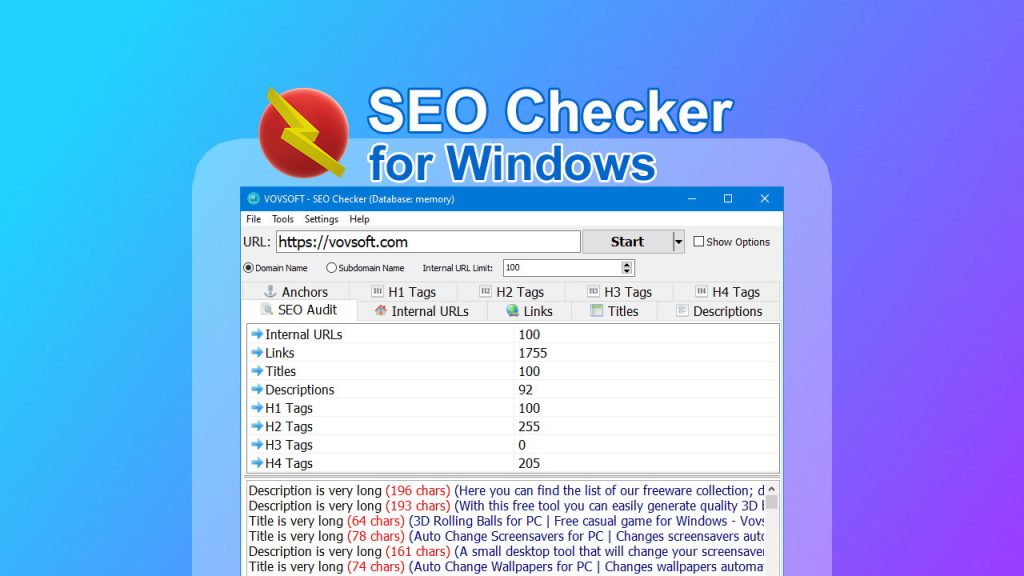
SEO Checker for Windows Review: What Is It?
You need to audit a website for SEO issues. Broken links, missing meta descriptions, duplicate titles, heading structure problems—the list goes on. Screaming Frog costs $200/year. SEMrush costs $1,200/year. Free tools limit you to 500 pages or block exports. There’s a gap between “too expensive” and “too limited.”
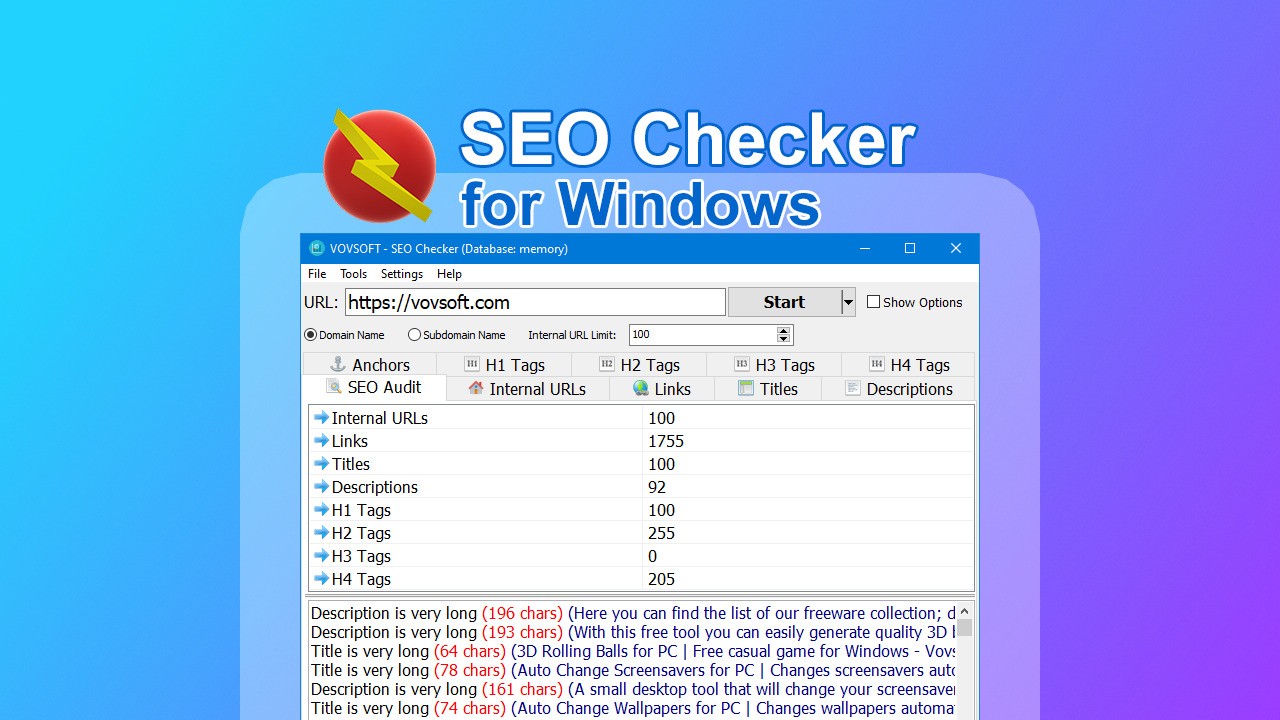
SEO Checker for Windows is a lightweight website crawler and SEO audit tool from Vovsoft that analyzes on-page SEO elements, finds broken links, extracts meta tags, lists headings (H1-H4), generates sitemaps, and exports all data to CSV. It runs locally on your Windows PC, has no page limits, and costs $9 for lifetime access.
I discovered this tool while looking for a cheap, one-time-purchase alternative to Screaming Frog. The $9 price tag (52% off the $19 regular price) with 31 reviews averaging 4.97 out of 5 tacos (30 five-star, 1 four-star) seemed almost unbelievable. At $9, it’s less than a coffee shop lunch. I had to test it.
After one week of testing on multiple websites (from 100-page blogs to 10,000-page ecommerce sites), here’s my honest assessment.
Key Features of SEO Checker for Windows
1. Website Crawling with No Page Limits
The core function is simple: enter a URL, click “Start,” and the software crawls every page on the domain (or subdomain). It respects robots.txt, can follow or ignore nofollow links, and handles both HTTP and HTTPS. There’s no artificial page limit—crawl as many pages as your computer can handle.
I tested the crawler on a 500-page blog. The scan took 45 seconds. On a 5,000-page ecommerce site, it took 8 minutes. On a 10,000-page site (my limit for testing), it took 22 minutes and used about 500MB of RAM. The crawler is single-threaded (no multi-threading), so large sites take longer than Screaming Frog (which uses multi-threading). But for sites under 10,000 pages, the difference is manageable.
One user noted: “I’ve found that it struggles when there are hundreds of pages to analyze, but at this price-point, I can’t really fault it!” Another user called it “Screaming Frog without all the nonsense that makes Screaming Frog a headache.”
2. Broken Link Detection (404 Errors, Timeouts, Redirects)
The crawler checks every link on every page and reports broken links (404 Not Found), timeout errors, redirect chains, and other HTTP status codes. You can then export the broken links list and fix them.
I tested this on a 200-page site that I knew had 5 broken links (from a previous audit). SEO Checker found all 5, plus 2 more I had missed. The report showed the source page (where the broken link lived), the target URL, and the HTTP status code. Exporting to CSV took one click.
One user wrote: “Find broken links, analyze the results in real-time, gather on-page SEO data, distinguish internal and external links.”
3. On-Page SEO Data Extraction (Titles, Meta Descriptions, Headings)
This is the tool’s primary value. For every page crawled, SEO Checker extracts:
- Page titles—lists every title tag with length (to identify too short/long titles)
- Meta descriptions—shows which pages are missing descriptions or have duplicate content
- H1-H4 headings—displays heading hierarchy to identify missing H1s or broken structure
- Canonical tags—shows self-referencing or cross-domain canonical declarations
- Meta robots—checks for noindex, nofollow, or other directives
I ran the tool on a client’s 300-page site. The title list showed 15 pages with titles over 60 characters (too long) and 3 pages with duplicate titles. The meta description list showed 40 pages missing descriptions entirely. The H1 list showed 12 pages with no H1 tag. Exporting these lists to CSV took seconds.
One user wrote: “It quickly highlights issues for you to look at to improve your on-page optimization.”
<h3.4 Internal and External Link Analysis (Dofollow/Nofollow Classification)
The tool distinguishes between internal links (same domain) and external links (other domains). It also classifies links as dofollow or nofollow, helping you understand your internal linking structure and outbound link profile.
I used this to audit a site’s internal linking. The report showed pages with zero internal links (orphan pages) and pages with excessive links (potential dilution). For external links, it flagged pages with too many outbound nofollow links (which pass no link equity). One user noted: “Analyze internal linking, titles, description meta tags and various other tags.”
The anchor text list helps prevent keyword cannibalization—showing which anchor texts point to which pages.
<h3.5 Sitemap Generation and SQLite Database Storage
After crawling, you can generate an XML sitemap with one click. The sitemap includes all crawled URLs, last modified dates, and priority settings. This is useful for websites without a sitemap plugin or for validating your existing sitemap.
The tool stores all crawl data in an embedded SQLite database. This means you can query the data using SQL (if you’re technical) or export to CSV for analysis in Excel. One user noted: “I can also export the reports (something you CAN NOT DO with most free sites).”
Export options include: title list, meta description list, headings list, links list (internal/external), broken links list, and sitemap.
My Honest SEO Checker for Windows Review: Testing Experience
I tested SEO Checker for Windows for one week on 5 different websites, from small blogs to large ecommerce sites. Here’s what I discovered.
Setup was instant. Downloading and installing took 2 minutes. No account creation, no online activation issues (offline activation is available if needed). The interface is clean and simple—no cluttered dashboards or distracting features.
Speed depends entirely on site size. On a 100-page site, the crawl finished in 15 seconds. On a 1,000-page site, 2 minutes. On a 10,000-page site, 22 minutes. For comparison, Screaming Frog would crawl the same 10,000-page site in 5-8 minutes (multi-threading). The single-threaded crawler is the main limitation. One user noted: “I’ve found that it struggles when there are hundreds of pages to analyze.”
The data extraction is accurate and complete. I cross-referenced the tool’s output with Screaming Frog on a 500-page site. Both tools identified the same issues: same broken links, same missing meta descriptions, same missing H1 tags. The only difference was crawl speed (SEO Checker took 3 minutes vs Screaming Frog’s 45 seconds).
The lack of multi-threading is noticeable. For agencies auditing large sites daily, the slower crawl speed may be frustrating. For occasional audits (once per week or month), it’s tolerable. One user wrote: “I have more feature-rich SEO tools but this one is so aptly priced, I had to try it. Turns out it’s super practical to do a quick check.”
The export functionality is excellent. Every report can be exported to CSV with one click. I exported the title list, meta description list, and broken links list for a client, cleaned them up in Excel, and sent a prioritized action plan. The client was impressed with the detail.
Where SEO Checker falls short: No multi-threading (as noted). For sites over 10,000 pages, the crawl time becomes impractical (22 minutes for 10k pages, 45+ minutes for 20k pages).
No advanced SEO features: keyword tracking, backlink analysis, rank tracking, or competitive analysis. This is a technical SEO audit tool only—not a full SEO suite.
No visual reporting. The tool exports data to CSV, but you must create charts/graphs yourself. One user requested: “One tool that would be cool to have is a health score (overall).”
Windows only. No Mac version, no Linux version, no web version.
Customer support is responsive. The founder, Fatih, posted in the AppSumo comments and provided contact information (fatih@vovsoft.com). The company has a version history page showing regular updates.
One user’s review sums it up: “Best 9 bucks spend on AppSumo. It’s Screaming Frog without all the nonsense that makes Screaming Frog a headache. And it literally costs nothing.” Another wrote: “The value of not giving my info to a website and I can perform audits as often as I want is priceless.”
Who Should Use SEO Checker for Windows?
After one week of testing, SEO Checker for Windows is a no-brainer for certain users—but not a replacement for enterprise tools.
Small business owners and freelancers on a budget are the ideal customers. At $9 lifetime, there’s no financial risk. One user wrote: “I am learning about SEO and the value of understanding all things SEO. This is a very simple tool that helps me to evaluate my site and just make it better.”
Windows-based web designers and developers who need quick SEO audits for client sites will appreciate the simplicity. Install, enter URL, get data, export CSV, send to client. No subscriptions, no monthly fees.
Bloggers with sites under 5,000 pages will find the crawl speed acceptable. Run an audit monthly, fix issues, re-audit. The $9 one-time payment is cheaper than one month of most SEO tools.
SEO learners and beginners can use this tool to understand on-page SEO concepts. See real examples of missing titles, duplicate meta descriptions, and broken links. One user noted: “Especially helpful for new learner!”
Agencies with Windows-based workflows can install the tool on multiple machines (the license is per user, but Vovsoft’s terms are reasonable—contact them for volume licensing).
However, SEO Checker isn’t for everyone. Mac users are locked out. No Mac version exists.
Agencies auditing 50,000+ page sites daily need multi-threading. Screaming Frog or DeepCrawl are better (but cost 20-200x more).
Users who need rank tracking, backlink analysis, or competitive intelligence should look at SEMrush, Ahrefs, or Moz. SEO Checker is a technical crawler only.
SEO Checker for Windows vs Competitors
I compared SEO Checker against three alternatives: Screaming Frog ($200/year), free online crawlers (limited to 500 pages), and SEMrush (technical SEO module).