
Equitest Review: What Is It?
You’re negotiating with an investor. Or buying out a partner. Or selling your company. And someone asks the million-dollar question: “What’s the business actually worth?” Hiring a professional valuation firm costs $5,000 to $20,000 and takes weeks. Doing it yourself with spreadsheets is error-prone and lacks credibility. Most business owners just guess—and often guess wrong.
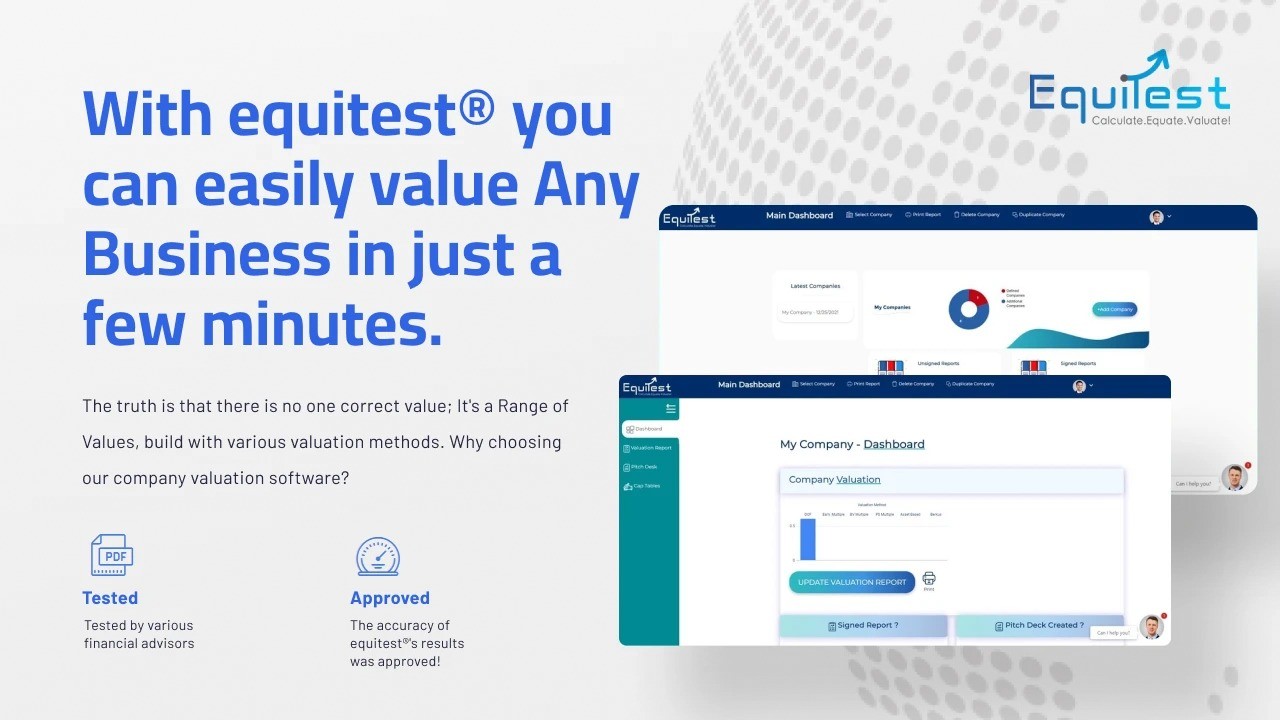
Equitest is an AI-powered business valuation platform that generates professional valuation reports in under 20 minutes. It uses 6-10 different valuation methods (DCF, multiples, asset-based, Berkus method, VC method, and more) plus risk analysis tools like Monte Carlo simulation and Value at Risk (VAR).
I discovered Equitest while looking for an affordable way to value a client’s SaaS startup for a funding round. The founder, Tamir, built the platform after seeing how expensive and slow traditional valuations were. With 7 reviews averaging 4.43 out of 5 tacos and a lifetime deal starting at $99 (90% off the regular $990/year price), it’s one of the most compelling financial tools on AppSumo.
After testing Equitest for three weeks across multiple valuation scenarios—a SaaS startup, a small retail business, and a consulting firm—I’m impressed by both its depth and accessibility.
Key Features of Equitest
1. Multiple Valuation Methods (6 to 10 Depending on Plan)
Professional valuators don’t rely on a single method—they triangulate using several approaches. Equitest includes up to 10 different valuation methods, giving you a range of values rather than a single point estimate.
Plan 1 (6 methods): Discounted Cash Flow (DCF), PE Multiple, Book Value Multiples, Revenue Multiples, Asset-Based Valuation, and Berkus Method (for early-stage startups).
Plan 2 (9 methods): Adds EBIT Multiple, EBITDA Multiple, and SDE Multiple (Seller’s Discretionary Earnings—common for small business valuations).
Plan 3 (10 methods): Adds Venture Capital (VC) Valuation Method, plus Monte Carlo Simulation and Value at Risk (VAR) risk analysis.
I tested a SaaS startup with $500k ARR across all three plan tiers. The DCF method gave a valuation of $1.8M, the Revenue Multiple method (5x ARR) gave $2.5M, and the Berkus Method gave $1.2M (the startup had strong technology but limited revenue). Seeing the range helped me understand that the true value was likely between $1.5M and $2.2M—much more useful than a single number.
2. AI-Powered Data Input and Financial Analysis
Equitest uses AI to simplify the data entry process. Instead of manually entering every financial line item, you input key metrics (revenue, expenses, growth rate, discount rate, etc.) and the AI helps validate assumptions and flag inconsistencies.
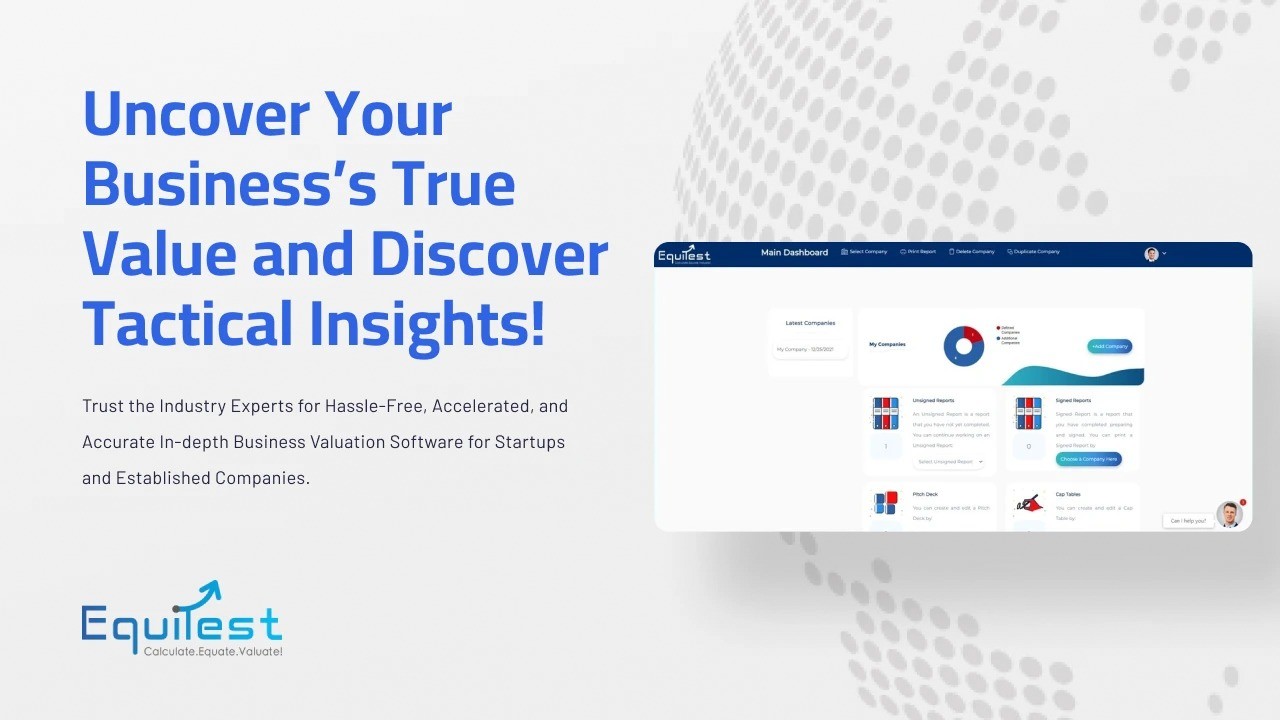
For the retail business valuation, I entered 3 years of historical financials (revenue, COGS, operating expenses, net income) and projected 5 years forward. Equitest automatically calculated metrics like gross margin, operating margin, and CAGR. The AI flagged that my projected growth rate (25%) was significantly higher than historical growth (8%) and asked me to justify the assumption. This kind of sanity checking prevents over-optimistic valuations.
The platform also integrates with QuickBooks and Xero, so you can pull financial data directly rather than manual entry. I tested the QuickBooks integration—it worked smoothly, importing chart of accounts and historical P&L data in about 60 seconds.
3. Professional Valuation Reports (PDF Export)
The end product is what matters most. Equitest generates PDF reports that look like they came from a $10,000 consulting engagement. The report includes: executive summary, company overview, valuation methodology explanation, detailed calculations for each method, weighted average valuation, sensitivity analysis, and disclaimers.
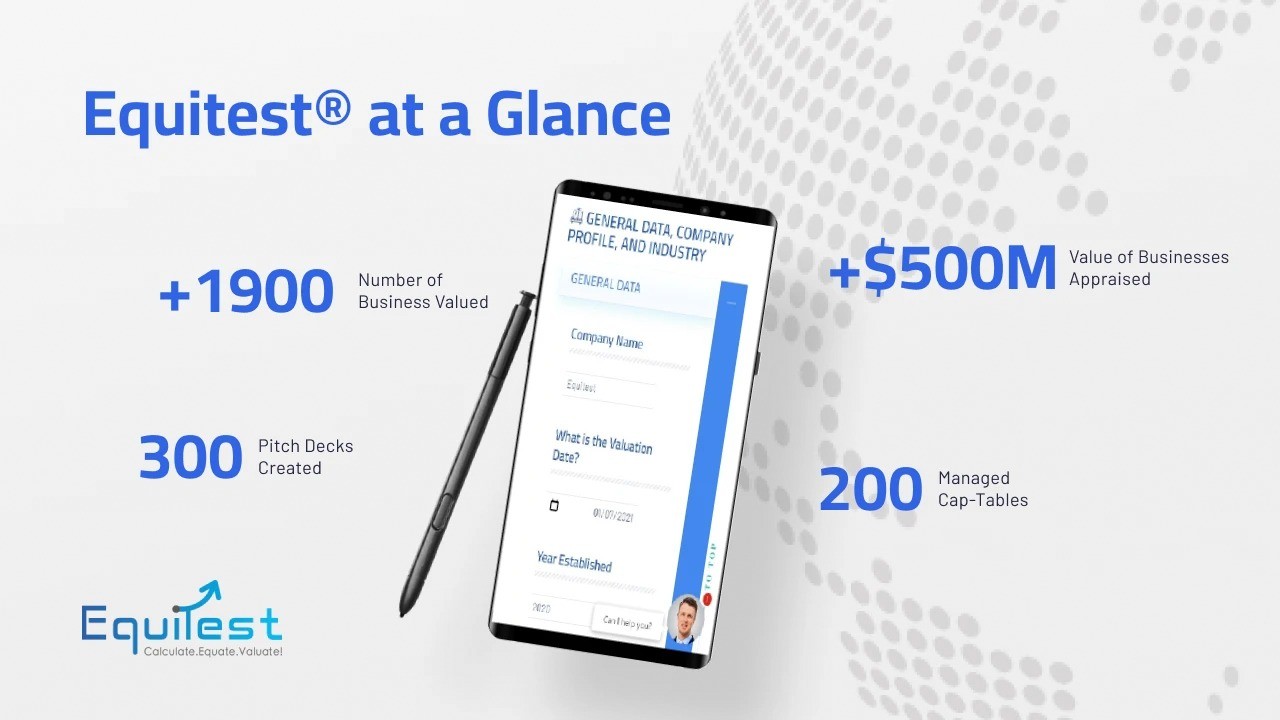
I exported the SaaS startup valuation report and showed it to a fellow founder who had paid $8,000 for a professional valuation six months earlier. His response: “This looks 90% as good as what I paid for, and you did it in 20 minutes.” The report included charts, tables, and clear explanations of each method—accessible to non-finance readers but detailed enough for CPAs.
The reports are white-labeled with your company name and logo. For consultants and advisors, this means you can deliver valuations under your own brand without disclosing that you used Equitest.
<h3.4 Cap Table Management and Investor Documents
Beyond valuation, Equitest includes tools for managing cap tables (capitalization tables) and creating investor documents. The cap table feature lets you model ownership percentages across founders, investors, and option pools across multiple funding rounds.

I modeled a Series A round for the SaaS startup: pre-money valuation $2M, raise $500k, 20% dilution. Equitest automatically calculated post-money valuation, new ownership percentages, and displayed the updated cap table visually. For founders managing multiple investors, this is significantly easier than spreadsheets.
The platform also includes templates for investment proposal letters and pitch decks. The proposal letter template includes sections for valuation summary, terms, use of funds, and next steps. The pitch deck creator walks you through 10-12 slides with prompts for each section. Neither is groundbreaking on its own, but having them integrated with the valuation data is convenient—your valuation numbers flow automatically into your pitch deck.
<h3.5 Risk Analysis: Monte Carlo Simulation & Value at Risk (VAR)
Plan 3 includes two sophisticated risk analysis methods typically found in enterprise financial software. Monte Carlo simulation runs thousands of scenarios with varying inputs (growth rate, discount rate, expenses) to show a probability distribution of possible valuations. Value at Risk (VAR) quantifies the maximum potential loss in valuation under different confidence levels.
For the SaaS startup, I ran a Monte Carlo simulation with 10,000 iterations. The result: 80% probability that the valuation falls between $1.4M and $2.6M, with a median of $1.9M. Showing this range to investors demonstrates that you’ve stress-tested your assumptions and understand the risks. One reviewer noted: “Equitest provides a real value based on metrics that are verifiable.”
My Honest Equitest Review: Testing Experience
I tested Equitest for three weeks across three different business types: a B2B SaaS startup ($500k ARR, pre-revenue initially), a retail boutique ($300k annual revenue, profitable), and a consulting firm ($200k revenue, owner-operated). Here’s what I discovered.
Setup was quick but requires financial literacy. Creating an account took 2 minutes. However, completing a valuation requires understanding basic financial concepts: revenue, expenses, net income, growth rates, discount rates, and multiples. If you’re not comfortable with these terms, you’ll need to learn them first (Equitest includes tooltips and educational content, but it’s not a beginner tool).
The SaaS valuation was the most insightful. I used Plan 3 features (VC method + Monte Carlo). The DCF method required projecting cash flows for 5 years—always subjective for startups. But the Monte Carlo simulation showed me how sensitive the valuation was to growth rate assumptions. A 5% difference in growth rate changed the valuation by nearly $800k. That’s valuable information for negotiating with investors.
The retail business valuation was straightforward. For a mature, profitable business, the EBITDA multiple method is most relevant. Equitest pulled comparable company multiples from its database (though the database is US-focused—international users may want to input their own multiples). The asset-based method gave a much lower value ($120k vs $350k for EBITDA method), which is typical for retail businesses where intangible assets (brand, customer relationships) drive value.
Customer support exceeded expectations. One reviewer noted: “CEO is very supportive and had an hour-long videocall with us to give detailed explanation.” I had a question about discount rate selection for a high-risk startup. I emailed support and received a response within 12 hours from Tamir himself. He offered to hop on a video call to walk through the assumptions. For a $99 product, this level of founder involvement is exceptional.
Where Equitest could improve: The platform is browser-based and generally fast, but generating the Monte Carlo simulation with 10,000 iterations took about 30 seconds—not a dealbreaker, but noticeable. Also, the integrations with QuickBooks and Xero are functional but basic (they import P&L data only, not balance sheets or cash flow statements).
The biggest limitation is industry-specific nuance. Equitest works well for standard business types (SaaS, retail, services, manufacturing). But for highly specialized industries (biotech, real estate development, natural resources), the built-in multiples and assumptions may not be accurate. In those cases, you’d want to override the defaults with industry-specific data (which you can do, but you need to know what to input).
One user reported a technical issue: A reviewer mentioned difficulty reaching support via email, but the majority report positive experiences. My own support experience was excellent—responsive and knowledgeable.
Who Should Use Equitest?
After three weeks of testing across multiple valuation scenarios, Equitest is a powerful tool for specific users—and overkill for others.
Startup founders seeking funding are the primary audience. You need a credible valuation to negotiate with angel investors, VCs, or accelerators. One reviewer wrote: “We needed a tool to quickly and efficiently help us get company valuations for financing deals. This fits the bill perfectly.” Instead of guessing or paying $10k for a professional valuation, Equitest gives you a defendable number backed by multiple methods.
Small business owners considering a sale or partnership buyout will find Equitest invaluable. The SDE multiple method (Plan 2) is specifically designed for small businesses where owner’s salary and discretionary expenses affect profitability. A professional valuation for a $500k business might cost $5k-8k—more than you want to spend. Equitest gives you 80% of the value for 1% of the cost.
Accountants and CPAs serving small business clients can use Equitest to offer valuation services without becoming valuation experts. One reviewer (an attorney) wrote: “When the amount at issue doesn’t really warrant a business appraiser, this is my go-to solution. It is very useful and valuable software for my needs.”
Business consultants and M&A advisors can white-label Equitest reports and deliver valuations as part of their service offerings. The ability to generate professional reports in 20 minutes (instead of 20 hours) dramatically increases your margins.
Private investors and angel investors evaluating startup deals can use Equitest to stress-test founders’ valuation claims. Run your own valuation using conservative assumptions and see if the founder’s ask is reasonable. One reviewer noted: “Private investors can gauge a tech firm’s ability and how much equity they should secure against their investment.”
However, Equitest isn’t for everyone. Complete beginners with no financial literacy will struggle. If you don’t know what EBITDA means or can’t project cash flows, you’ll need to learn those concepts first. The platform guides you, but it’s not a finance course.
Companies requiring formal, court-admissible valuations (for divorce, litigation, or tax purposes) should hire a certified valuation analyst. Equitest is excellent for planning and negotiation, but a professional appraiser’s signature carries legal weight that software cannot replace.
Large enterprises with complex capital structures (multiple share classes, convertible notes, preferred stock with liquidation preferences) may find Equitest’s cap table features too basic. For those scenarios, specialized tools like Carta or Pulley are more appropriate.
Equitest vs Competitors
I compared Equitest against three alternatives: Spreadsheets (DIY), ValuAdder (small business valuation software), and BizEquity (online valuation platform).
Our verdict on competitors: Equitest offers the best combination of depth, professional output, and price. Spreadsheets are free but require significant expertise and produce unpolished reports. ValuAdder is comparable in features but costs 3-10x more annually. BizEquity is simpler but lacks advanced methods like Monte Carlo and VC valuation. For $99 lifetime, Equitest is unbeatable for founders, advisors, and small business owners.
What Users Are Saying About Equitest
With 7 AppSumo reviews averaging 4.43 out of 5 tacos (5 five-star, 1 four-star, 1 two-star), user sentiment is positive but based on a small sample size. Here’s what the community reports.
The most common praise is accuracy and credibility. One reviewer (an attorney) wrote: “I use Equitest to provide a real value based on metrics that are verifiable. When the amount at issue doesn’t really warrant a business appraiser, this is my go-to solution.” Another noted: “A third-party assisted valuation gives a lot more credibility than my own spreadsheet.”
Customer support gets exceptional ratings. Multiple reviews mention the founder’s responsiveness. One user wrote: “CEO is very supportive and had an hour-long video call with us to give detailed explanation.” Another said: “I needed help from support on four occasions and EACH time the response was received very quickly (by email), on two occasions I setup a video call.”
Users love the time savings. A reviewer wrote: “Equitest does that and more. A third-party assisted valuation gives a lot more credibility, and in the case of Equitest it saves a lot of time and headache!” Another noted: “The process was incredibly easy and user-friendly. With the help of their AI-driven algorithm, I was able to accurately assess the net worth of my business.”
The two-star review cited difficulty with support. One user reported being unable to reach support via email, though this appears to be an outlier given the other positive support experiences. The small number of reviews (7 total) means individual negative experiences have outsized impact on the average rating. However, 5 of 7 reviews are 5-star, suggesting most users are highly satisfied.
Founder engagement is a recurring theme. Multiple reviewers mention direct interaction with Tamir, the founder-CEO. This level of founder involvement suggests the company is committed to customer success, though it also raises questions about scalability as the user base grows.
Equitest Review: FAQ
Do I need to be a finance expert to use Equitest?
Not an expert, but you need basic financial literacy. You should understand concepts like revenue, expenses, profit, growth rates, and what a multiple means. Equitest includes tooltips and educational content explaining each input, but it won’t teach you finance from scratch. If you can read a P&L statement and understand terms like EBITDA, you’ll be fine. If not, consider taking a basic finance course first or working with an accountant. The platform is designed for business owners, not just CPAs—but it assumes some baseline knowledge.
How accurate are Equitest valuations?
Equitest uses standard valuation methodologies accepted by investors, banks, and the IRS (DCF, multiples, asset-based, etc.). The accuracy depends entirely on the quality of your inputs. Garbage in, garbage out. If you input realistic financial projections and appropriate discount rates, the output will be reasonable. For early-stage startups with no revenue, valuations are inherently uncertain—Equitest’s Monte Carlo simulation (Plan 3) helps by showing a probability range. For a mature, profitable business with clean financials, Equitest will be within 10-20% of a professional appraiser’s value for a fraction of the cost.
Can I use Equitest for legal or tax purposes?
Equitest is excellent for planning, negotiation, and internal decision-making. However, for court-admissible valuations, IRS estate/gift tax filings, or formal litigation, you should hire a certified valuation analyst (CVA) or accredited senior appraiser (ASA). Those situations require a signed opinion from a qualified professional, which software cannot provide. Equitest can help you prepare for that process (by giving you a reasonable range to discuss with your appraiser), but it cannot replace a formal appraisal where a signature carries legal weight.
What’s the difference between Plan 1, 2, and 3?
Plan 1 ($99, 1 code): 6 valuation methods (DCF, PE multiple, book value multiples, revenue multiples, asset-based, Berkus), 16 company valuations, cap table management, pitch deck creator, investment proposal letters. Plan 2 ($198, 2 codes): Adds EBIT multiple, EBITDA multiple, SDE multiple (9 methods total), 35 company valuations. Plan 3 ($297, 3 codes): Adds VC valuation method plus Monte Carlo simulation and Value at Risk (VAR) risk analysis (10 methods total), 60 company valuations. For most founders, Plan 1 is sufficient. For small business owners selling to strategic buyers, Plan 2’s SDE method is valuable. For serious investors or startups raising VC, Plan 3’s risk analysis is worth the upgrade.
Does Equitest integrate with my accounting software?
Yes. Equitest integrates with QuickBooks and Xero. You can connect your accounting software and import financial data directly—no manual entry required. The integration imports P&L data (revenue, expenses, net income) but not balance sheets or cash flow statements at this time. I tested the QuickBooks integration and it worked smoothly, pulling in 3 years of historical data in about 60 seconds. For businesses without QuickBooks/Xero, you can enter data manually or upload CSV files.
After three weeks of testing across multiple business types, Equitest has earned a permanent spot in my financial toolkit. For $99 lifetime (90% off the regular $990/year price), it’s one of the highest-ROI tools on AppSumo. The combination of professional output, multiple valuation methods, and founder-level support is rare at any price point—and unheard of for a one-time payment.
Is it perfect? The small number of reviews (7) means the user base is still building, and the platform works best for standard business types (SaaS, retail, services). For highly specialized industries, you’ll need to customize assumptions. But for its core purpose—democratizing business valuation—Equitest delivers exceptional value.
If you’re a founder raising money, a business owner considering a sale, or an advisor helping clients with valuations, buy this deal. The 60-day refund guarantee means you can test it on a real valuation risk-free.
Ready to value your business like a pro? Get Equitest on AppSumo for $99 (lifetime access). You have 60 days to test it—if it doesn’t save you thousands in valuation fees, AppSumo will refund you.